Choosing the 2026 best Hardwood Floor Glue requires more than comparing price, drying time, or brand popularity. Global buyers face different substrates, humidity levels, installation standards, and indoor-air requirements. A product suited to a dry European apartment may fail on a humid coastal project.
Market data shows why this decision matters. Grand View Research estimates that the global wood flooring market will continue expanding through 2030, supported by residential renovation and commercial construction. Mordor Intelligence also identifies rising demand for flooring adhesives with lower emissions and stronger moisture resistance. These reports describe market direction, not a universal product winner. That distinction matters.
No single adhesive works everywhere.
Brett Miller, Vice President of Education and Certification at the National Wood Flooring Association, states: “Wood is hygroscopic; it gains and loses moisture as environmental conditions change.” His observation explains why professional installers examine concrete moisture, room humidity, wood acclimation, and adhesive elasticity before installation. A rigid glue can become a problem when a floor moves seasonally.
This guide compares Hardwood Floor Glue by bond strength, moisture tolerance, open time, cleanup, VOC considerations, and compatibility with engineered or solid wood. It also considers standards such as ASTM D3498 and EN 14293, where applicable. Buyers should still confirm the latest technical data sheet and local requirements. Labels can be confusing. Testing conditions are not identical. A low-emission claim does not automatically guarantee suitability for every project.
The practical goal is simple: match the adhesive to the floor, climate, substrate, and installer’s method. That sounds obvious. It is often missed.
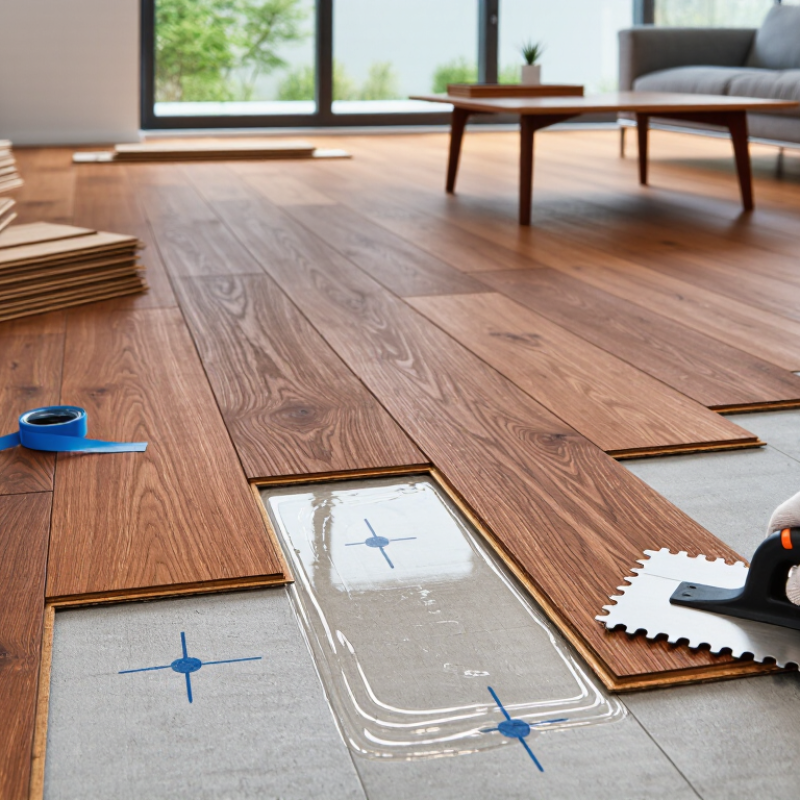
Hardwood floor glue is a formulated adhesive that bonds timber boards to a prepared subfloor. It is not simply a sticky liquid. Most modern products use polymer or hybrid chemistry, allowing the adhesive to remain slightly flexible after curing. This movement matters because wood expands and contracts with humidity.
The adhesive works through contact, wetting, and curing. An installer spreads it with the correct notched trowel, creating controlled ridges beneath each board. These ridges support coverage and allow the adhesive to grip the subfloor. As moisture or chemical components trigger curing, the glue changes from a workable paste into an elastic bond. The bond transfers daily foot traffic while reducing hollow sounds and minor movement.
Subfloor preparation decides much of the result. It should be clean, dry, level, and structurally sound. Concrete may also need moisture testing. A surface can look dry but still release damaging vapor. That mistake is easy to make. Experienced installers check temperature, humidity, and adhesive open time before laying boards. They also leave suitable perimeter gaps for natural wood movement.
Global buyers should review the technical data sheet, safety information, curing time, and required application tools. Local climate changes performance expectations. A product suitable for a dry interior may behave differently in a humid coastal region. I have seen projects focus on strong initial grip while ignoring future movement. That choice can create stress, gaps, or lifted boards later. No glue corrects poor substrate preparation.
Hardwood floor adhesives differ in chemistry, curing method, and moisture tolerance. Moisture-curing polyurethane adhesives suit solid wood and engineered boards. They remain flexible as timber expands and contracts. This matters in coastal or seasonal climates. However, installers must control substrate moisture carefully. Too much moisture can weaken the bond.
Silane-modified polymer adhesives offer strong adhesion with useful elasticity. They usually produce low odor and support many indoor applications. They are practical for apartments, offices, and heated floors.
Epoxy adhesives provide high strength and excellent resistance to moisture. They work well on difficult substrates, but their rigidity may stress moving wood. Water-based adhesives can reduce emissions, yet they require suitable wood and subfloor conditions.
A site inspection should guide the selection. Check concrete moisture, surface flatness, temperature, and ventilation. Read the technical data sheet, not only the product label. Regional standards may also differ. Buyers should request test reports, coverage data, curing times, and chemical safety information. A small mock-up can reveal poor spreading or slow curing before full installation.
One overlooked detail is the installer’s trowel technique. Adhesive thickness changes performance. Too little glue leaves hollow areas. Too much may delay curing. Even experienced teams can misjudge unfamiliar timber species. That mistake deserves attention. Local climate, transport storage, and job-site timing can affect the final result.
Choosing hardwood floor glue starts with the wood, not the bucket. Solid oak expands and contracts more than engineered planks. Narrow boards usually tolerate more movement than wide boards. For moisture-sensitive species, use an adhesive rated for dimensional movement and confirm its open time. In my installation experience, a glue that spreads smoothly at 20°C may become difficult near 10°C. Temperature changes matter.
The subfloor decides the risk. On concrete, test internal relative humidity with ASTM F2170 methods, not only a surface meter. The NWFA 2023 Installation Guidelines commonly reference a 4-percentage-point moisture difference between wood flooring and wood subfloors. Concrete limits vary by adhesive system, often around 75% RH, but the technical data sheet controls. Never treat that number as universal. It is an easy mistake.
Installation method changes glue selection. Full-spread installation needs stable coverage and sufficient working time. A floating floor requires an adhesive designed for joint bonding, while nail-assisted installation may need only targeted support. Check trowel size, vapor-control claims, curing time, and compatibility with radiant heating. The Resilient Floor Covering Institute and ASTM F710 both emphasize clean, dry, structurally sound substrates for flooring work. A dusty slab can defeat expensive glue. I still find “universal” products tempting, but universal often means compromise. Test a small area, measure spread rate, and document moisture readings before committing.
Choosing the best hardwood floor glue in 2026 requires more than bond strength. No adhesive is best everywhere. International buyers should request a current safety data sheet, technical data sheet, and batch traceability. These documents should identify chemical hazards, ventilation needs, curing times, and disposal guidance. Check labels against GHS requirements and the destination market’s language rules. A product meeting one regional standard may still need additional testing elsewhere. Look for documented performance under relevant EN, ASTM, or national flooring standards, not vague claims.
Climate changes installation risk. In humid coastal warehouses, open containers can absorb moisture before use. In cold regions, adhesive may thicken and cure slowly. Concrete moisture testing, wood acclimation, and controlled indoor temperature matter as much as the adhesive itself. During site checks, installers should record substrate moisture, room temperature, and relative humidity. Small records prevent large disputes. Some low-emission formulas reduce indoor exposure, but “low odor” does not automatically mean harmless. Confirm VOC data, curing ventilation, and worker protection requirements.
For cross-border purchasing, packaging must survive freezing, heat, and rough handling. Ask for storage limits and transport conditions before ordering pallets. I would also test a small lot on the actual subfloor. Laboratory results cannot predict every dusty slab or fast-changing climate. A practical trial may expose poor spreadability, staining, or delayed cure. That extra step feels slow. It is cheaper than replacing a finished floor.
Safety, standards, and climate factors for international adhesive selection
2026 Best Hardwood Floor Glue for Global Buyers
Selecting hardwood floor glue requires more than comparing bond strength. Match the adhesive with the wood species, subfloor, plank width, and indoor climate. A professional installer should check subfloor moisture with a calibrated meter. Dust, weak concrete, or uneven surfaces can cause early failure. Clean the surface carefully, then spread adhesive with the recommended notched trowel. Keep the ridges even. Press boards firmly and maintain expansion gaps around walls.
Tips: Test a small area first. Record temperature, humidity, batch number, and open time. Use the manufacturer’s technical data and safety sheet for local compliance. A simple pull test after curing can reveal weak adhesion, but it does not replace laboratory testing. I have found that rushed preparation causes more problems than adhesive selection.
Performance testing should include shear strength, moisture resistance, and dimensional movement. Test samples after normal curing and after controlled humidity changes. Check for hollow sounds, edge lifting, and visible gaps. Results may differ between laboratories and real homes. That difference deserves attention. During long-term maintenance, control indoor humidity, wipe spills quickly, and avoid soaking the floor. Inspect high-traffic areas every few months. Replace damaged boards before moisture reaches the subfloor. Some installation plans look perfect on paper but fail because ventilation, cleaning habits, or seasonal movement were underestimated.
| Section | Evaluation Dimension | Typical Data or Recommended Range | Application, Testing, or Maintenance Guidance |
|---|---|---|---|
| Adhesive Selection | Silane-Modified Polymer Adhesive | Flexible, moisture-curing adhesive; commonly suitable for engineered wood and many solid-wood installations when approved by the flooring manufacturer. | Useful where dimensional movement and sound reduction are important. Confirm compatibility with the subfloor, wood finish, and local indoor-air-quality requirements. |
| Adhesive Selection | Polyurethane Adhesive | Moisture-curing adhesive with strong adhesion and good resistance to intermittent moisture exposure. | Suitable for many wood-to-concrete applications. Protect the adhesive from excess water during curing and follow the specified working time. |
| Adhesive Selection | Water-Based Dispersion Adhesive | Low-odor, water-based formulation; generally used with dimensionally stable engineered flooring and porous substrates. | Usually requires a dry, absorbent subfloor. It may be unsuitable for moisture-sensitive solid wood or non-absorbent substrates unless specifically approved. |
| Adhesive Selection | Two-Component Reactive Adhesive | Resin-and-hardener system with high bond strength and reliable curing on selected difficult or non-absorbent substrates. | Requires accurate component mixing, controlled pot life, and careful residue removal. Use suitable ventilation and personal protective equipment. |
| Global Buyer Checklist | Technical Documentation | Technical data sheet, safety data sheet, installation instructions, batch information, storage limits, and declared coverage. | For international purchasing, also check language availability, transport classification, shelf life, customs requirements, and regional VOC or emissions rules. |
| Global Buyer Checklist | Flooring Compatibility | Compatibility should be confirmed for the wood species, board construction, board width, finish type, subfloor, and installation method. | Obtain written approval when installing wide solid planks, exotic species, end-grain blocks, or flooring with unusual factory coatings. |
| Site Preparation | Subfloor Flatness | A common installation target is approximately 3 mm variation over a 2 m straightedge, subject to the flooring and adhesive specification. | Grind high spots and repair low areas with a compatible leveling compound. Do not use adhesive to compensate for major unevenness. |
| Site Preparation | Concrete Moisture | Many adhesive systems specify concrete internal relative humidity limits in the approximate range of 75% to 85% RH; the product limit controls. | Test according to ASTM F2170 where applicable. If moisture exceeds the adhesive limit, delay installation or use an approved moisture-mitigation system. |
| Site Preparation | Concrete Surface Condition | Surface must be structurally sound, clean, dry, and free from dust, curing compounds, oil, paint, and weak laitance. | Prepare concrete in accordance with ASTM F710 principles. Mechanically remove contaminants and vacuum thoroughly before adhesive application. |
| Site Preparation | Wood Moisture Content | In many temperate indoor environments, wood flooring is commonly conditioned near 6% to 9% moisture content, with the actual target based on local equilibrium conditions. | Measure several boards from each shipment. Do not install until the flooring and subfloor moisture conditions are within the flooring manufacturer’s specified range. |
| Application Steps | Acclimatization | Condition flooring in the installation area for the period specified by the flooring supplier, commonly several days rather than a fixed universal number. | Maintain stable indoor temperature and humidity before, during, and after installation. Avoid storing wood directly on damp concrete. |
| Application Steps | Adhesive Temperature | Many systems perform best when the adhesive, subfloor, and room are within approximately 15°C to 25°C. | Follow the product temperature range. Cold adhesive spreads poorly, while excessive heat can shorten open time and working time. |
| Application Steps | Trowel Selection | Notched trowel size is commonly selected to provide continuous transfer, often resulting in approximately 0.8 to 1.5 kg/m² consumption depending on the system. | Use the specified trowel and replace worn trowels. Periodically lift a board to verify adhesive transfer across the intended contact area. |
| Application Steps | Open Time and Working Time | Typical open or working times range from approximately 30 to 60 minutes, but temperature, humidity, porosity, and airflow can change the result. | Spread only an area that can be covered within the stated time. Do not install over skinned or partially cured adhesive. |
| Application Steps | Adhesive Transfer | Target consistent wet transfer over most of the board underside; full transfer is especially important at board ends and joints. | Press or roll boards according to the installation instructions. Immediately remove adhesive from the finished surface using the approved cleaning method. |
| Application Steps | Expansion Clearance | A perimeter movement gap is commonly required; many wood-flooring systems use approximately 10 to 15 mm, but board width and climate can require more. | Do not bridge the required perimeter gap with adhesive, skirting, fixed cabinets, or other rigid components. |
| Application Steps | Curing and Traffic | Light foot traffic is often possible after approximately 12 to 24 hours, while full cure commonly requires 24 to 72 hours. | Keep heavy furniture, rolling loads, wet cleaning, and rugs away until the adhesive has reached the specified cure stage. |
| Performance Testing | Initial Bond and Coverage | Record adhesive batch, trowel type, spread rate, ambient conditions, and transfer percentage during a site mock-up. | Lift a newly placed board during the working period. Inadequate transfer indicates an incorrect trowel, contaminated substrate, insufficient adhesive, or expired working time. |
| Performance Testing | Moisture Resistance | Performance depends on the adhesive chemistry and the manufacturer’s tested moisture limit; no adhesive makes a wet subfloor acceptable. | Use ASTM F2170 or another locally accepted concrete moisture method before installation. Retest areas with unusual readings or visible dampness. |
| Performance Testing | Shear or Peel Adhesion | Compare bond behavior using conditioned test specimens rather than relying on a single universal pass value. | For formal qualification, use the applicable flooring or parquet adhesive method, such as EN 14293 or ISO 17178 where relevant to the market. |
| Performance Testing | Dimensional Movement | Flexible adhesives can accommodate limited seasonal movement, but they cannot replace correct acclimatization, expansion gaps, and humidity control. | Inspect test panels through heating and cooling cycles for hollow spots, edge lift, cracking, or adhesive failure at the interface. |
| Performance Testing | Sound and Comfort | Acoustic improvement varies with adhesive thickness, floor construction, substrate, and room assembly; it should be measured as an installed system. | Use the same boards, substrate, and installation method when comparing products. Avoid comparing isolated adhesive data with complete floor-system results. |
| Long-Term Maintenance | Indoor Climate | A commonly recommended indoor range for wood flooring is approximately 30% to 60% relative humidity, with a stable temperature near 18°C to 27°C. | Use humidification or dehumidification where necessary. Large seasonal swings can cause board gaps, cupping, crowning, or stress at adhesive joints. |
| Long-Term Maintenance | Routine Cleaning | Use dry dust removal frequently and a well-wrung, slightly damp mop with a cleaner approved for the floor finish. | Do not flood the floor or use steam cleaners unless the flooring and finish supplier explicitly permits them. |
| Long-Term Maintenance | Surface Protection | Use entrance mats, felt pads, protective casters, and soft footwear policies in high-traffic areas. | Keep abrasive grit and standing water away from the floor. Lift furniture instead of dragging it across the boards. |
| Long-Term Maintenance | Inspection Frequency | Inspect high-traffic and moisture-prone areas at least twice a year, and inspect sooner after leaks, flooding, or HVAC failures. | Look for hollow sounds, open joints, edge lifting, staining, odor, or soft areas. Investigate the moisture source before repairing the floor. |
| Long-Term Maintenance | Repair Strategy | Localized repairs may be possible for isolated board movement, while widespread failure usually indicates a substrate, moisture, or installation issue. | Identify the failure mode before selecting an injection adhesive, board replacement, sanding, or full removal. Follow the floor-finish repair requirements. |
| Storage and Safety | Storage Conditions | Store containers sealed, upright, and protected from frost, direct sunlight, and excessive heat; shelf life is product-specific. | Use stock rotation based on batch date. Do not use material that has gelled, separated abnormally, exceeded shelf life, or has damaged packaging. |
| Storage and Safety | Worker Protection | Required controls vary by formulation and may include gloves, eye protection, ventilation, and respiratory protection. | Read the current safety data sheet before use. Dispose of cured and uncured residues according to local waste regulations. |
Moisture-curing polyurethane adhesive suits solid wood and engineered boards. It stays flexible during seasonal expansion and contraction. Check substrate moisture carefully. Too much moisture can weaken the bond.
They provide strong adhesion with useful elasticity. They usually have low odor. They suit apartments, offices, and heated floors. Good indoor ventilation still matters.
No. Epoxy offers high strength and moisture resistance. Its rigidity may stress moving wood. Use it mainly on difficult, stable substrates. It is not always the safest choice.
Water-based adhesive can reduce emissions. It requires suitable wood and subfloor conditions. Check moisture, temperature, and compatibility before installation. Lower odor does not guarantee better performance.
Inspect concrete moisture, surface flatness, temperature, and ventilation. Review the technical data sheet carefully. Request coverage data, curing time, test reports, and safety information. Labels alone are insufficient.
Solid oak moves more than engineered planks. Wide boards usually move more than narrow boards. Moisture-sensitive wood needs movement-rated adhesive. Confirm its open time at the actual site temperature.
Dust, weak concrete, uneven areas, and excess moisture can cause early failure. The surface must be clean, dry, and structurally sound. A dusty slab can defeat expensive adhesive.
Yes. Full-spread installation needs even coverage and enough working time. Floating floors need joint-bonding adhesive. Nail-assisted installation may need targeted support. Always check trowel size and heating compatibility.
Create a small mock-up first. Record temperature, humidity, batch details, and open time. Check spreading, curing, hollow sounds, and edge lifting. A simple pull test helps, but it is not laboratory proof.
Control indoor humidity and wipe spills quickly. Avoid soaking the floor. Inspect busy areas every few months. Replace damaged boards before moisture reaches the subfloor. Perfect plans sometimes miss cleaning habits.
This guide explains how Hardwood Floor Glue bonds wood flooring to a suitable subfloor, helping create a stable, durable, and comfortable surface. It compares major adhesive types, including water-based, solvent-free, moisture-curing, and hybrid formulas, while highlighting how their flexibility, strength, curing time, and moisture resistance affect performance. Global buyers will learn how to match glue with solid or engineered wood, concrete or plywood subfloors, and installation methods such as full-spread, floating, or spot application.
The article also addresses practical selection factors, including climate, humidity, ventilation, indoor air quality, transportation conditions, and regional safety standards. Clear application steps cover subfloor preparation, adhesive placement, plank alignment, curing, and cleanup. Performance testing methods help evaluate bond strength, moisture tolerance, dimensional movement, and long-term stability before large-scale use. Finally, routine inspection, humidity control, and timely repairs are presented as essential maintenance practices for preserving the floor’s appearance and structural performance in different international markets.

Jinfang